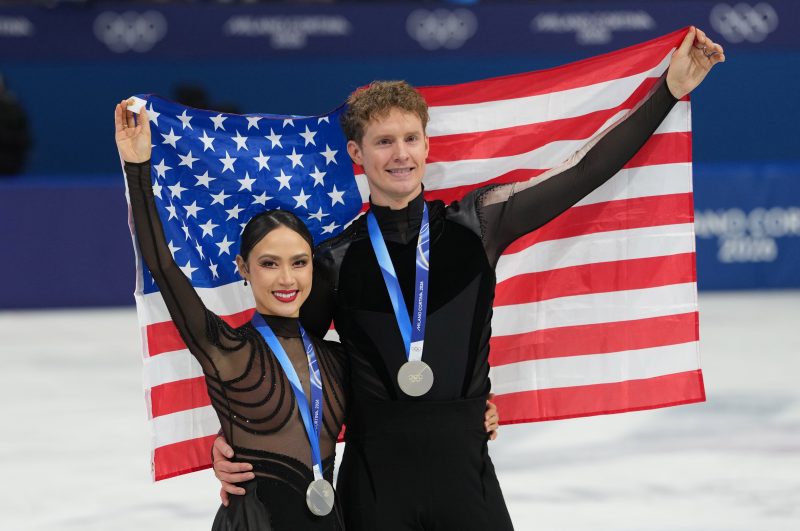
Americans Madison Chock and Evan Bates won the silver medal in ice dance at the 2026 Winter Olympics.
The French team of Laurence Fournier Beaudry and Guillaume Cizeron won gold, a decision that stirred controversy.
A breakdown of the scores shows the French judge gave the largest point differential in favor of the French team.
Chock and Bates said they were proud of their performance and felt they couldn’t have skated any better.
MILAN — The biggest question in figure skating right now: How did Madison Chock and Evan Bates not win ice dance gold at the 2026 Winter Olympics?
The married duo were the favorites entering these Games, but had to settle for silver with the French team of Laurence Fournier Beaudry and Guillaume Cizeron winning gold. The decision stirred sharp reaction from American fans and fellow U.S. figure skaters on social media and elsewhere. The enduring sentiment is that Chock and Bates performed a flawless free dance strong enough to lock up gold.
Beaudry and Cizeron, who carried a 0.46-point lead entering the night, had a good but not as sharp skate. However, they ended up with a better score: a 135.64 to Chock and Bates’ 134.67 – a victory margin of 1.43 points.
How did it happen? Here’s how the judges’ scores for both teams broke down and what they reveal.
Watch Winter Olympics on Peacock
How is ice dance scored in figure skating? Free dance scores, explained
Let’s start with how free dances are scored.
The program comprises two scores: a technical score and a component score. The technical score is made up of how each skater executes their spins, jumps and step sequences. They are graded on a level from one to four, with four being the highest.
The component score values the composition, presentation, and skating skills of the program, such as the choreography and how it connects with the music.
The aim of the free dance program is to pull off ‘an entertaining, moving and inspiring performance that looks effortless despite its difficulty. Innovative choreography, timing and rhythm are paramount,’ according to U.S. Figure Skating.
Chock and Bates finished with a 76.75 technical elements score and a 57.92 program components score. Comparatively, Beaudry and Cizeron had a technical elements score of 77.06 and a program components score of 58.58.
What were free dance judges’ scores?
There were nine judges total for the free dance. Chock and Bates earned top scores from five judges, while Beaudry and Cizeron had top scores from four judges. But let’s take a closer look at each judge’s score to understand more.
Czech judge Richard Kosina awarded Beaudry and Cizeron the highest score of the bunch, a 138.49, and scored Chock and Bates at 135.23. The biggest gap, however, came from French judge Jezabel Dabouis, who gave Beaudry and Cizeron a 137.45 and gave Chock and Bates a 129.74 – a 7.71 point difference. That 129.74 is also the lowest score for Chock and Bates of any of the nine judges.
Additionally, Spanish judge Marta Olozagarre scored Beaudry and Cizeron at a 137.03, and Chock and Bates at 132.75, which put them in third in her standings behind Canadians Piper Gilles and Paul Poirier, who went on to win bronze.
U.S. judge Janis Engel awarded Chock and Bates their highest score, a 137.67, and gave Beaudry and Cizeron a 133.57, their third-lowest score of the bunch.
Judge-by-judge score breakdown:
Beaudry and Cizeron: 137.45 (Judge 1, France), 134.19 (Judge 2, Georgia), 137.03 (Judge 3, Spain), 130.94 (Judge 4 Finland),133.57 (Judge 5, USA), 136.49 (Judge 6, Canada), 134.40 (Judge 7, Italy), 133.26 (Judge 8, China), 138.49 (Judge 9, Czechia), 135.64, (Total segment score)
Chock and Bates: 129.74 (Judge 1, France), 134.88 (Judge 2, Georgia), 132.75 (Judge 3, Spain), 130.97 (Judge 4 Finland), 137.97 (Judge 5, USA), 135.47 (Judge 6, Canada), 135.75 (Judge 7, Italy), 136.95 (Judge 8, China), 135.23 (Judge 9, Czechia), 134.67 (Total segment score)
What were technical elements for Chock and Bates, Beaudry and Cizeron?
Here were the technical elements and scores for Chock and Bates.
Choreographic assisted jump and lifting movement: 4.89
Curve lift: 15.29
Synchronized twizzles: 9.54
Choreographic character step sequence: 5.13
One foot turn sequence: 8.90
Rotation lift: 7.78
Dance spin: 8.25
Diagonal step sequence: 12.08
Choreographic sliding movement: 4.89
Here were the technical elements and scores for Beaudry and Cizeron.
Synchronized twizzles: 8.44
One foot turn sequence: 9.48
Rotational lift: 7.71
Dance spin: 8.41
Curve lift: 15.70
Serpentine step sequence: 11.93
Choreographic assisted jump and lifting movement: 5.01
Choreographic character step sequence: 5.25
Choreographic dance lift: 5.13
Madison Chock, Evan Bates reaction to judges’ scores
In figure skating, judges don’t have to elaborate on their decisions, but fans and figure skaters of past and present are trying to understand how this decision came to be.
Chock and Bates felt like they gave a ‘gold medal performance’ and were emotional after the medal ceremony, calling it a ‘bittersweet’ result. In the news conference for the medalists, the skaters were asked if the judges’ scores accurately reflected their performance.
‘We put out our very best skates every time we took Olympic ice,’ Chock said. ‘All four performances we had here at the Olympics, we’re very proud of. They were flawless for us. We couldn’t have skated any better, and we’re super proud with how we took the ice, how we handled ourselves every time. The rest is out of our hands.’
The silver was the first ice dance Olympic medal for Chock and Bates in what is their fourth and likely last Winter Olympics. They are two-time gold medalists in the team event, most recently here in Milan.