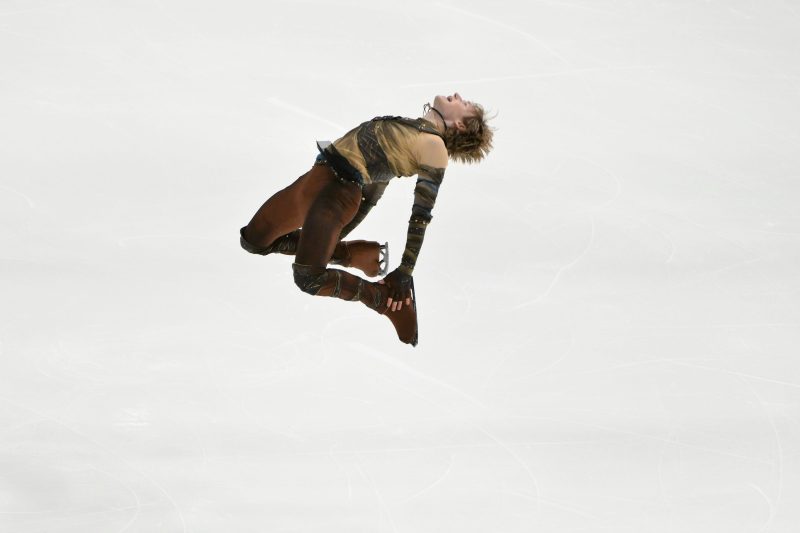
ST. LOUIS — The ‘Quad God’ has entered the chat at the 2026 U.S. figure skating championships. And punctuated his entry with a fist pump.
Malinin completed two quadruple jumps, including a quad Lutz, and a back flip en route to posting a first-place 115.10. Second-place Tomoki Hiwatashi earned a 89.26 and third-place Jason Brown posted an 88.49.
“I just came into this competition just to see what happens out there and I impressed myself, I didn’t know I could skate that good,’ Malinin said after.
Milan Magic: Listen on Apple, Spotify or wherever you get your podcasts.
The three-time defending U.S. champion will almost certainly make it four in a row after his free skate Saturday, setting him up for a mega 2026 Winter Olympics, which’ll be his first.
To start the day’s action, the dominant ice dance duo of Madison Chock and Evan Bates put on a spectacular rhythm dance to capture first place with a whopping 91.70. They are aiming to capture their fifth straight U.S. crown.
On Friday, Amber Glenn, Alysa Liu and Isabeau Levito take the ice to settle the women’s championship while Alisa Efimova and Misha Mitrofanov vie to close out the pairs championship.
Here are all the highlights, scores, reactions and standings from Day 2 of nationals.
Ilia Malinin’s short program
Malinin gave a fist pump when he wrapped, and the crowd started tossing stuffies of Toothless from How to Train Your Dragon onto the ice.
Maxim Naumov’s emotional short program
It was one of the most anticipated programs of the night. The championships were going to be emotional for Maxim Naumov, who lost his parents in the January 2025 plane crash that devasted the skating community.
It wasn’t the cleanest performance, but that didn’t matter. The crowd rallied behind him and he closed out strong, receiving a standing ovation as he sat on the ice.As he awaited his score, he held up a photo of him as a kid with his parents, holding their hands, all three on an ice rink.
Naumov received a score of 85.72, putting him in first place. He looked stunned and cried, holding the picture and kissing it for one of the most emotional moments of the week.
U.S. figure skating championships results, men’s short program scores
Here are the standings after the men’s short program.
Ilia Malinin: 115.10 total segment score, 67.15 technical elements score, 47.95 program components score.
Tomoki Hiwatashi: 89.26 total segment score, 47.62 technical elements score, 41.64 program components score.
Jason Brown: 88.49 total segment score, 42.82 technical elements score, 45.67 program components score.
Maxim Naumov: 85.72 total segment score, 44.57 technical elements score, 41.15 program components score.
Andrew Torgashev: 84.99 total segment score, 44.48 technical elements score, 41.51 program components score.
Daniel Martynov: 81.63 total segment score, 43.15 technical elements score, 38.48 program components score.
Jacob Sanchez: 81.27 total segment score, 41.79 technical elements score, 39.48 program components score.
Liam Kapeikis: 78.87 total segment score, 40.38 technical elements score, 38.48 program components score.
Kai Kovar: 76.91 total segment score, 40.16 technical elements score, 36.75 program components score.
Lucius Kazanecki: 75.72 total segment score, 40.71 technical elements score, 35.01 program components score.
Jimmy Ma: 75.56 total segment score, 37.50 technical elements score, 38.06 program components score.
Goku Endo: 72.68 total segment score, 35.10 technical elements score, 37.58 program components score.
Lorenzo Elano: 71.65 total segment score, 35.36 technical elements score, 37.29 program components score.
Samuel Mindra: 65.02 total segment score, 29.70 technical elements score, 36.32 program components score.
Emmanuel Savary: 60.21 total segment score, 25.19 technical elements score, 35.02 program components score.
Michael Xie: 59.95 total segment score, 26.13 technical elements score, 33.82 program components score.
Will Annis: 54.95 total segment score, 24.16 technical elements score, 31.79 program components score. He had a one-point deduction for a fall.
Ken Mikawa: 51.69 total segment score, 23.93 technical elements score, 28.76 program components score. He had a one-point deduction for a fall.
Ilia Malinin on his short program
Malinin on how his short program makes him feel: ‘This short program is really emotional for me, and I get this feeling of I go through these different battles, these different fights or emotions of just feelings or processes of life, and it’s really just an emotional piece. Both this and the long program are really just spiritually and the feeling of it is so deep, and I really want the audience to feel that.’
‘Quad God’ of figure skating: Ilia Malinin’s nickname
Simply put, Ilia Malinin has the greatest array of jumps any figure skater in history has ever possessed. He’s launched himself into the air for seven quadruple jumps in a single long program at last month’s Grand Prix Final and was the first skater to land a quad Axel.
Malinin’s username used to be Lutz God, but he changed it to Quad God after landing his first quad jump.
“i didn’t think much about it … Days go by and people started asking, ‘Why’d you name yourself Quad God, you only landed one jump,’’ he said on Milan Magic, USA TODAY’s new Olympics podcast that drops its first episode Saturday. ‘And then I was like, ‘Oh, OK maybe I should be come a Quad God.’ From there I found my rhythm of landing quad after quad after quad and then of course landing the first quad axel.”
“In the most humble way possible, I think it’s definitely helped my confidence in not only to skating in general but just feeling like I deserve to be recognized as who I am.”
Madison Chock and Evan Bates put up season-best performance
Another rhythm dance, another night starting off with a bang.
Madison Chock and Evan Bates continued their U.S. championship dominance with an elite performance to their Lenny Kravitz medley, catapulting themselves to the top of the leaderboard with a score of 91.70, a season-best mark.
It gives them a healthy margin after the first night of skating in the ice dance, nearly six points ahead of the second place team of Christina Carreira and Anthony Ponomarenko. It’s common for Chock and Bates to take a big, early lead, this time putting them in great position for a fifth-straight U.S. title.
Ilia Malinin’s parents
Malinin was born into figure skating. His mother, Tatiana Malinina, is from the Soviet Union, Siberia specifically, and competed at 10 consecutive world figure skating championships for Uzbekistan. She finished eighth at the 1998 Winter Olympics in Nagano, the competition in which Tara Lipinski won the gold medal and Michelle Kwan the silver. Malinina finished fourth at the 1999 world championships as well, and she also competed at the 2002 Salt Lake City Olympics, but withdrew after the short program with the flu.
Malinin’s father, Roman Skorniakov, represented Uzbekistan at the same two Olympics, 1998 and 2002, finishing 19th both times. He and Malinina were married in 2000 and became skating coaches in the United States, moving to the Northern Virginia suburbs of Washington, D.C., where, in December 2004, Ilia was born. He took the Russian masculine form of his mother’s last name because his parents were concerned that Skorniakov was too difficult to pronounce.
US figure skating rhythm dance scores, standings
Here are the running standings for rhythm dance.
Madison Chock and Evan Bates: 91.70 total segment score, 53.13 technical elements score, 38.57 program components score.
Emilea Zingas and Vadym Kolesnik: 85.98 total segment score, 49.88 technical elements score, 36.10 program components score.
Christina Carreira and Anthony Ponomarenko: 83.29 total segment score, 47.86 technical elements score, 35.43 program components score.
Caroline Green and Michael Parsons: 80.55 total segment score, 45.94 technical elements score, 34.61 program components score.
Emily Bratti and Ian Somerville: 79.43 total segment score, 45.88 technical elements score, 33.55 program components score.
Oona Brown and Gage Brown: 75.72 total segment score, 43.07 technical elements score, 32.65 program components score.
Katarina Wolfkostin and Dimitry Tsarevski: 74.99 total segment score, 42.30 technical elements score, 32.69 program components score.
Eva Pate and Logan Bye: 73.54 total segment score, 41.29 technical elements score, 32.25 program components score.
Leah Neset and Artem Markelov: 71.28 total segment score, 40.84 technical elements score, 30.44 program components score.
Maia Shibutani and Alex Shibutani: 71.25 total segment score, 39.66 technical elements score, 31.58 program components score.
Elliana Peal and Ethan Peal: 69.90 total segment score, 39.44 technical elements score, 30.16 program components score.
Amy Cui and Jonathan Rogers: 67.60 total segment score, 38.00 technical elements score, 29.60 program components score.
Isabella Flores and Linus Colmor Jepsen: 66.37 total segment score, 37.82 technical elements score, 28.55 program components score.
Raffaella Koncius and Alexey Shchepetov: 65.15 total segment score, 36.12 technical elements score, 29.03 program components score. The pair had their program interrupted by a music issue at the arena, stopping their program for a few minutes. They went to the referee’s table to discuss where in the program and song they should pick back up.
Vanessa Pham and Anton Spiridonov: 61.41 total segment score, 33.49 technical elements score, 27.92 program components score.
Team USA figure skating roster
The Olympic team will be named on Sunday, Jan. 11 at 2 p.m. Three men and three women singles skaters will be chosen, as will three ice dance teams and two pairs, 16 athletes in all. The USFS selection process includes past performances, focusing on the athlete’s body of work over the past two seasons.
Ice dancing vs. figure skating
Ice dancing is a type of figure skating that does not feature jumps or lifts. Ice dancing is made up of two segments, the rhythm dance and the free dance.
What Chock and Bates said before tonight’s rhythm dance
Here’s how Evan Bates said they are feeling going into nationals: ‘I think at this point we understand how special and unique the opportunity is to skate at an Olympic Games and this is the last competition before Milan, so we’re using it as a building block, and we’re excited to go out on the ice today.’
Get Olympics updates in your texts! Join USA TODAY Sports’ WhatsApp Channel
How does Ilia Malinin train for his quad jumps?
Malinin shared with Christine Brennan and Brian Boitano on Milan Magic, USA TODAY’s new Olympics podcast that drops its first episode Saturday, that he likes to skate a full program at least once a day, but that doesn’t mean every jump in that practice session must be a quad. It depends on how his body feels.
“For me, at least the standard base can be all triple jumps, just to keep that stamina, just to keep that stamina in there. But then, of course, depending on how I feel or how the training is going, then I can say, ‘Maybe tomorrow I can go for a full quad layout or maybe do a full quad and the rest can be triples.’
“I think the main focus for me is just running the whole program in itself with all the jumps, all the spins and really just getting that muscle memory in your head because I think a lot of the times, especially with me, if I do a certain amount of triple jumps and I feel comfortable with it, then I can go and the quad jumps will get a little easier for me because I’ve been practicing that muscle memory for a while.”
Milan Magic: Listen on Apple, Spotify or wherever you get your podcasts.
Types of figure skating jumps
Toe jump: A skater drives the toe pick of their non-takeoff foot into the ice to launch themselves into the air and generate momentum into the jump.
Toe loop: A skater takes off backward and lands on the same back edge of their blade.
Lutz: A skater moving backward jumps off the back outside edge of their skate and uses the toe-pick of their other skate to catapult into the air in the opposite direction and lands on the back outside edge of the picking leg.
Flip: A skater launches off the back inside edge of one skate and lands on the back outside edge of the other skate.
Edge jump: A skater takes off not with their toe pick but off the edge of their skate.
Salchow: A skater launches off the back inside edge of one skate and lands on the back outside edge of their other skate.
Axel: The only forward-facing jump, a skater lands on the back outside edge of their non-takeoff foot while traveling backward. The axel is the hardest jump because of the extra half-revolution that comes with a forward takeoff and a backward landing.
Loop: The skater jumps off a back outside edge of their skate and lands on the same edge.
How Jason Brown feels going for third Winter Olympics
In a time where the young stars headline U.S. figure skating, Jason Brown is out to prove he still has it.
The 31-year-old burst onto the scene in 2014, when he went viral and earned a spot on the 2014 Winter Olympics team, eventually winning a bronze medal. Afterward, he thought he would call it quits, but he still had more to give and made it back to the Winter Games in 2022. Again, he thought he was done after that.
But in 2026, Brown is back at it for what could be the last dance. He heads into the 2026 U.S. figure skating championships with a chance to make Team USA for a third time, and he’ll try to do it with something that helped him reach stardom. That something is a blast from the past, and making it to the 2026 Winter Olympics would remain just as special.