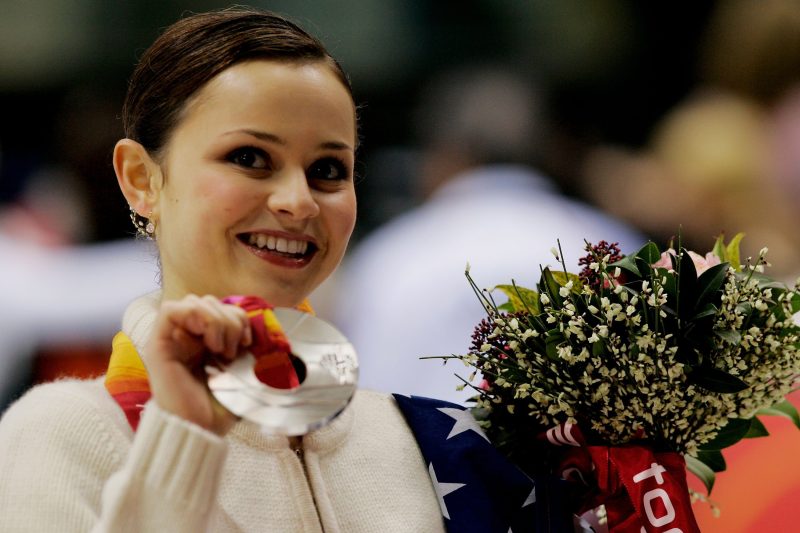
Twenty years ago, I was on the Olympic podium in Turin, Italy. Now, I’m back as a spectator, watching the figure skating events with both nostalgia and relief as I relive the highs and lows of my Olympic experience. I was keenly reminded of my own choice to pursue the Olympic dream at the expense of all else.
It stirred reflections on my skating career and all that has transpired since. Knowing what it took, I would still do it again in a heartbeat. At the same time, it’s hard to imagine my kids following in my footsteps — not only because of what I missed out on, but the weight of the hopes and expectations I carried.
I first fell in love with the feeling of gliding across the ice at age seven. The next 10 years were full of joyful growth, quickly mastering difficult jumps, and early competitive success. Early mornings in cold damp ice rinks were filled with possibility and promise. I couldn’t get enough and hated anything keeping me away from the ice.
But when I was just 12, I was forced to take months off when another skater collided with me, slicing my calf open. Then again at 15 I fractured my lower back, sidelined for another three months. The time away from the ice only strengthened my resolve and commitment to qualify for the 2002 Olympic Games in Salt Lake City. I made the games, but missed the podium and ended up a disappointing 4th place, determined to come back in 2006 and redeem myself.
I moved across the country to work with a coach known internationally for minting Olympic champions, shutting down any outside interests. It paid off and I had my best year yet, winning almost every competition I entered.
But the time between the Olympics is long. Two years in and still a long two years out; stress mounted and joy faded. 2004 was a particularly brutal year; I withdrew from a season of competitions, crippled by mental health struggles and tortured by long, anxiety ridden nights, precipitated by the growing fear that my best days were behind me.
Just two years earlier, I was a fresh upstart with almost no senior international experience. Making the Olympic team as a 17-year-old in my home country felt like there was only possibility ahead.
Four years later, in 2006, I knew most of my career was behind me, and I was weighed down by the tremendous weight of expectation —mine, and my country’s. It was most likely my last shot at Olympic gold, but injuries marred my training leading up to the Games.
That’s the thing about an Olympic career, one can spend a whole lifetime training for a certain moment in time, only to be thwarted by the body’s limits.
I knew that even one mistake would cost me Gold and that two would likely knock me off the podium. In the end, I stumbled but so did my competitors. I took home the silver.
The Olympics are the most glorious and, arguably, agonizing of human endeavors. With the gift of time, I am profoundly aware of the dark side that we glaze over, often oblivious to the costs. The world isharsh in judging our hero athletes — the media’s adulation over team medal counts obscures each athlete’s individual and very human trials and tribulations, focusing on times, records, and outcomes.
In 2006, I was alone on the world stage, and blamed only myself when I fell.
If falling was hard, harder still was walking away. After two decades spent mastering my sport, I finally hung up my skates and found myself profoundly disoriented as the sense of self I achieved as a result of years of hard work on the ice, quickly disintegrated.
But in the best moments, I was able to transcend place and time, losing myself in the music. I felt the audience on the edge of their seats, cheering me on, and sharing in my triumphs. My short program in Turin was one of those moments.
All of this played out for me when most young adults are headed off to college, experiencing their first real taste of independence, making lifelong friendships, and charting out what direction their careers might take. Their mistakes won’t be scrutinized in the public eye (at least that was largely the case before social media) and for most, passing final exams is the biggest source of stress.
Part of me wishes that I, too, could have had those rights of passage.
Yet looking back at my life choices, I would absolutely do it all over again. Medaling at the Olympics was the realization of a dream that I had and committed to achieving in a way few people can ever understand. Other than having children, it was the most profound and meaningful part of my life and for that, I would not exchange it for anything.
These days, my world now revolves around two little people — constantly testing boundaries and figuring out who they are. I want my kids to know that accomplishing great things takes work.
I want them to know the priceless triumph of overcoming their fears because they chose to show up, despite the nerves and doubt. But when success is defined by perfection in one particular moment, that’s a tough way to live and it’s not for everyone. It’s a deeply personal and consequential choice. And yet, I would never want them to miss pursuing their dreams because the cost of admission is too high.
Sasha Cohen is the 2006 Olympic silver medalist, 2006 U.S. Champion, 2003 Grand-Prix Final Champion, and a three-time World medalist. Following her competitve career, she graduated from Columbia University’s General Studies and now works as a financial analyst.